The Great Shift:
From LSTMs to Transformers

A Pedagogical Journey through Attention, Memory, and Parallelization

Use Arrow Keys to Navigate →

The Two Flaws of the LSTM

Long Short-Term Memory (LSTM) networks ruled AI from 2014-2017. But they were fundamentally limited by their architecture—the Conveyor Belt.

  • 1. Information Bottleneck (Amnesia): Information from Word 1 has to mathematically pass through Word 2, Word 3... all the way to Word N. In a 2,000-word essay, the first word's signal is completely diluted by the time it reaches the end.
  • 2. Sequential Training (Speed): Context for Word 50 cannot be calculated until Word 49 is finished computing. Because it relies on a sequential for loop, it cannot be trained efficiently on modern parallel GPUs.
LSTM Conveyor Belt Metaphor

LSTMs process tokens strictly one-by-one, causing massive traffic jams.

The Amnesia Test: Mathematical Proof

The `amnesia_test_demo.py` script proves this limitation mathematically.

Strings of 20 random letters are generated. Both an LSTM and a Transformer are tasked to memorize and output the very first letter of the sequence.

Because the LSTM must pass the letter 'K' through 19 subsequent hidden states, the gradient vanishes, and the context is forgotten entirely.

The Amnesia Test Output

Theoretical Takeaway: LSTMs suffer from the Vanishing Gradient problem over long sequences, whereas Transformers retrieve context perfectly via Attention.

===================================================== THE AMNESIA TEST: LSTM vs Transformer (Context Memory) ===================================================== Unseen Test String: 'K N M B E G J S V L N J T Y H O O A Y S' Target Answer: 'K' ----------------------------------------------------- LSTM Predicted: 'A' (Failed! The Vanishing Gradient destroyed memory) Transformer Predicted: 'K' (Success! Attention instantly retrieved the first letter)

The Transformer Revolution

In 2017, Google published "Attention Is All You Need". They abandoned the sequential conveyor belt entirely.

Instead of passing a hidden state down a line, the Transformer builds a Web of Connections. Every single word connects directly to every other word simultaneously.

The "Path Length" from Word 1 to Word 10,000 is O(1). It is a direct, instant mathematical connection.
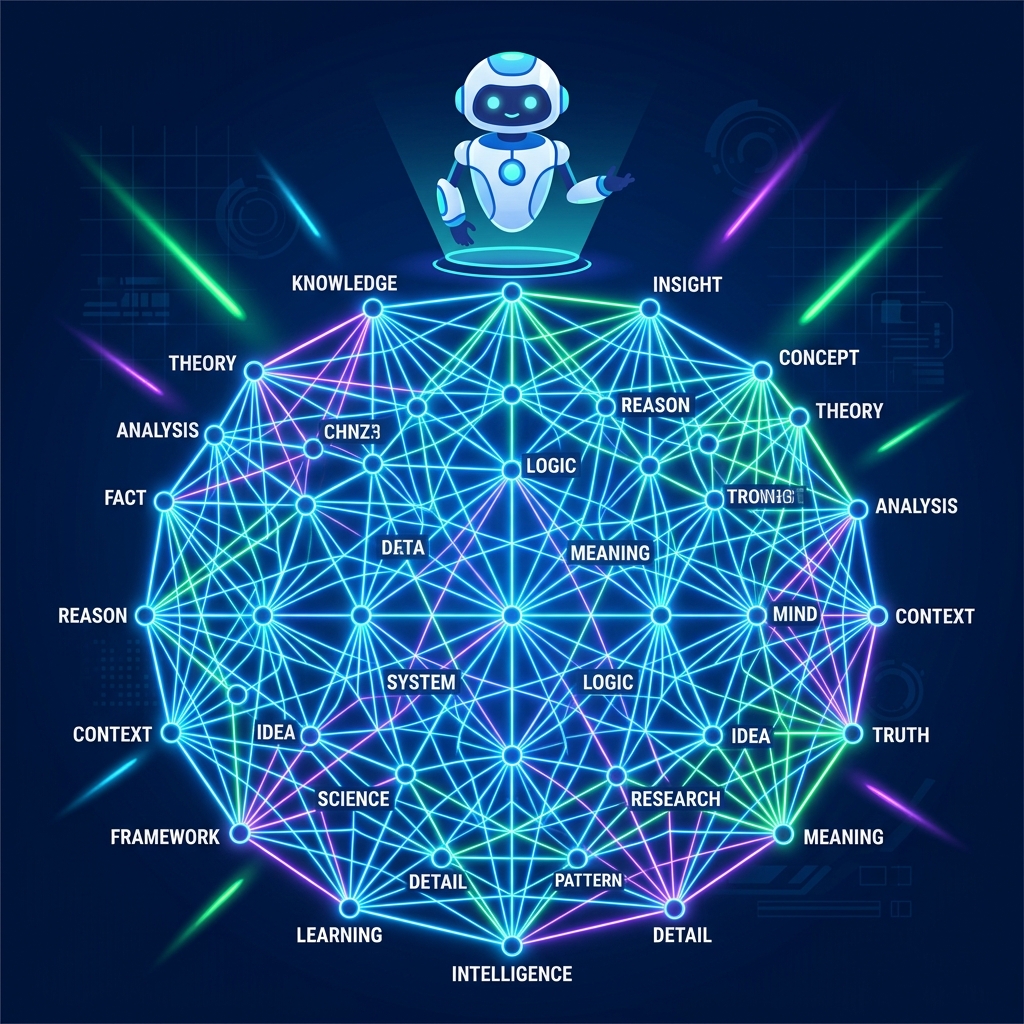
Transformer Attention Web

Self-Attention allows every token to directly analyze every other token instantly.

How Attention Works: The Cocktail Party Effect

Imagine being at a noisy cocktail party. When talking to someone, all other voices are instantly tuned out to focus entirely on them. This is what the Transformer does using three matrices: Query, Key, and Value (Q, K, V).

  • Query (Q): "What am I looking for?"
    (e.g., The word 'The' broadcasts: "I am an article looking for a noun")
  • Key (K): "What am I?"
    (e.g., The word 'Bank' broadcasts: "I am a noun related to finance/rivers")
  • Value (V): "What is my actual underlying meaning?"

When a Query matches a Key (via Dot Product), the model absorbs that Value. If 'The' matches perfectly with 'Bank', it absorbs 99% of 'Bank's' meaning to understand its own context.

The Math of Attention

The `transformer_deep_dive.py` script traces this exact Matrix Math.

By multiplying the Query matrix by the Key matrix and applying a Softmax function, a grid of percentages is produced.

Notice how the model mathematically assigns exactly 14% of its attention to the word "network" to understand the context of the word "propose".

The Attention Matrix Output

Theoretical Takeaway: The Softmax function ensures that attention is strictly distributed as a percentage (summing to 1.0), meaning the model perfectly balances its focus across the entire sequence.

Attention Weights (Softmax applied to scaled scores) Observe how every row perfectly sums to 1.0 (100% distribution) We propose a new simple network architec the Transfor We 0.04 0.07 0.05 0.17 0.06 0.14 0.06 0.20 0.19 | Σ=1.00 propose 0.06 0.05 0.05 0.23 0.06 0.14 0.08 0.14 0.21 | Σ=1.00 a 0.04 0.05 0.04 0.21 0.05 0.14 0.05 0.24 0.18 | Σ=1.00 new 0.11 0.10 0.06 0.12 0.12 0.11 0.19 0.04 0.15 | Σ=1.00 simple 0.03 0.04 0.03 0.22 0.04 0.14 0.07 0.13 0.28 | Σ=1.00 network 0.21 0.11 0.18 0.07 0.12 0.08 0.12 0.06 0.05 | Σ=1.00

Watching the Model Learn

Backpropagation is applied to this math in `transformer_training_demo.py`.

At Epoch 0, the Q, K, V matrices are completely random, meaning the model hallucinates gibberish.

During training, these matrices are automatically adjusted to align perfectly with English grammar rules, steadily dropping the loss to zero.

The Training Progression

Theoretical Takeaway: As the loss decreases, the Attention Matrices learn to map relationships correctly (e.g. adjectives to nouns), transforming random guesses into coherent text.

► EPOCH 0 (Untrained Model) Explanation: The weights are random. The model is guessing blindly. Loss: 5.8054 Target: propose a new simple network architecture, the Transformer Output: squeeze parsing MHA ALIGN machine SSD Peephole WFM ------------------------------------------------------------------ [Running Backpropagation... Fine-tuning the weights] ► EPOCH 160 Loss: 0.4844 Target: propose a new simple network architecture, the Transformer Output: propose a deep simple network architecture, the Transformer ------------------------------------------------------------------ [Running Backpropagation... Fine-tuning the weights] ► EPOCH 240 Loss: 0.4626 Target: propose a new simple network architecture, the Transformer Output: propose a new simple network architecture, the Transformer

The Speed Benchmark

Why do Transformers scale to trillions of parameters? Because they eliminated the for loop.

The `lstm_vs_transformer_race.py` script processes a massive 1,000-word document in pure Python.

The LSTM is forced to wait for the previous word 1,000 times. The Transformer computes all 1,000 words simultaneously via matrices.

The Speed Benchmark Output

Theoretical Takeaway: The Transformer’s parallel $O(1)$ architecture utilizes hardware accelerators infinitely better than the LSTM's sequential $O(N)$ architecture.

THE SPEED BENCHMARK: SEQUENTIAL vs PARALLEL ► Testing LSTM (O(N) Sequential Process)... Time taken: 0.4053 seconds (The LSTM was forced to pause and wait for the previous word 1,000 times!) ► Testing Transformer (O(1) Parallel Process)... Time taken: 0.2198 seconds (The Transformer calculated all 1,000 words simultaneously using Matrices!) ============================================================ CONCLUSION: The Transformer is 1.8x faster at training time! ============================================================

The Grand Finale: The Generative Showdown

Finally, both fully trained models are given the prompt "We propose a". Because the LSTM struggles with long dependencies, it loses track of grammar and hallucinates. The Transformer maintains $O(1)$ context and generates perfectly coherent, domain-specific text. This is how ChatGPT works!

► LSTM GENERATION: LSTM thinks next word is: global (Context: We propose a) LSTM thinks next word is: context (Context: We propose a global) LSTM thinks next word is: network (Context: We propose a global context) LSTM Final Output: We propose a global context network architecture, the LSTM ------------------------------------------------------------ ► TRANSFORMER GENERATION: Transformer thinks next word is: channel (Context: We propose a) Transformer thinks next word is: attention (Context: We propose a channel) Transformer thinks next word is: neural (Context: We propose a channel attention) Transformer Final Output: We propose a channel attention neural model, the SENet
1 / 13