Chapter 2:
Layers of Intelligence

Unraveling the Magic Behind AI, Machine Learning, Deep Learning, and Generative AI

Technology Public Lecture

1. Introduction: Untangling the Web

Artificial Intelligence (AI) has become deeply embedded in every aspect of our daily lives. But what's really going on behind the curtain of magic?

The Common Mix-Up:

Most people use AI, Machine Learning, and Deep Learning as if they mean the same thing. While they're intimately related, they're actually quite different.

Let's use a simple analogy to make sense of it all!

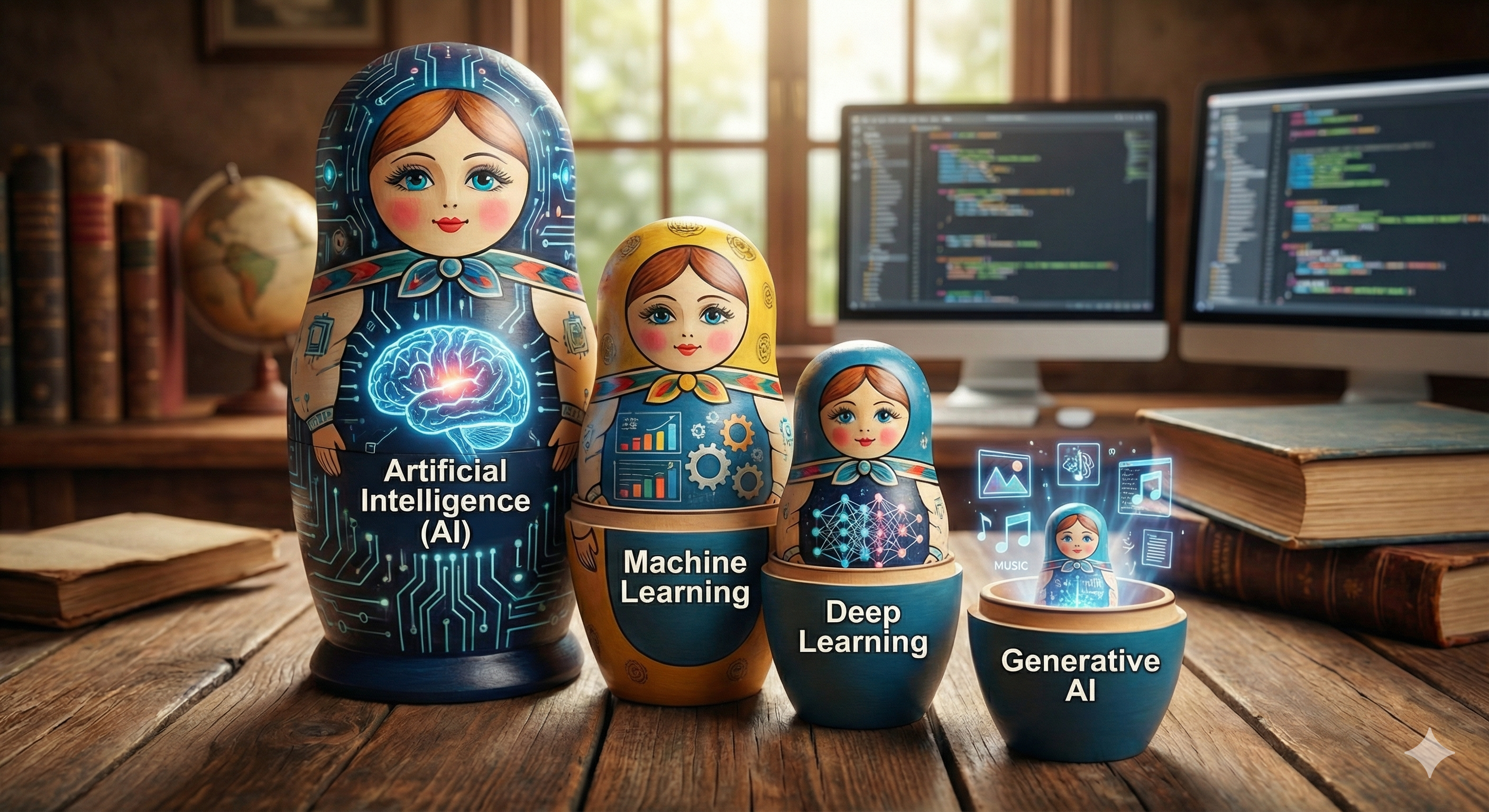
Russian Nesting Dolls Matryoshka

2. The Russian Doll Analogy

Think of Russian Matryoshka dolls — those charming wooden dolls that nest inside one another, each smaller than the last.

  • Outermost Doll: Artificial Intelligence (AI)
  • Next Layer: Machine Learning (ML)
  • Deeper Still: Deep Learning (DL)
  • At the Core: Generative AI

They're not competing technologies — they're layers of intelligence, each building upon the last.

3. The Outermost Layer: Artificial Intelligence

Artificial Intelligence (AI): This isn't a single technology — it's an umbrella term covering any technique that enables machines to mimic human intelligence.

The Ultimate Goal

Build machines that can think, reason, understand language, and solve problems — sometimes even better than humans can.

Artificial Intelligence Big Picture

4. Two Types of Players

1. Narrow AI

"The Specialist"

Every AI system we interact with today is narrow AI.

  • Masters of a single domain or task.
  • A chess-playing AI can't make you coffee — it only knows chess!
  • Think of it as: A world-class specialist in one field.

2. General AI (AGI)

"The All-Rounder"

The holy grail of AI research — still theoretical.

  • Could learn and adapt to any task, just like humans do.
  • Solve math problems in the morning, write poetry at lunch, and counsel patients in the afternoon.
  • Think of it as: A true polymath — skilled across every domain.

5. Two Paths of AI (Not Enemies, Partners)

School 1: Symbolic AI School 2: Machine Learning
"Strict Teacher Method" "Smart Student Method"
Explicitly program human knowledge as rules into the system. Skip the rules — feed it data and let it figure things out.
IF patient has fever THEN give Paracetamol (Expert Systems). Show thousands of images and teach "this is a cat".
Provides clear structure & logic. Provides flexibility and endless learning capability.

6. AI in the Art World: A Debate

Théâtre d'Opéra Spatial

In 2022, the painting that won first prize at the Colorado art exhibition wasn't created by a human, but by an AI called Midjourney.

Questions it raised:

  • Can we call an AI-created work 'art'?
  • Who is the true artist?
  • Is creativity exclusive to humans?
Abstract Art representation

Second Doll:
Machine Learning

This isn't just a technology; it's a revolutionary that tore up the 'Old Testament' of computing and wrote a 'New Testament'!

7. The Paradigm Shift: Rules vs Learning

1. Traditional Programming (The Old Way)

Like following a strict cookbook. The computer executes instructions but can't improvise.

Data + Rules = Answers

Example: Website tax calculation.

2. Machine Learning (The Revolution)

Here's where it gets interesting — we flip the entire equation!

Data + Answers = Rules

The system learns to create its own rules! Example: Teaching a computer to recognize cats.

Hacker / Spam representation

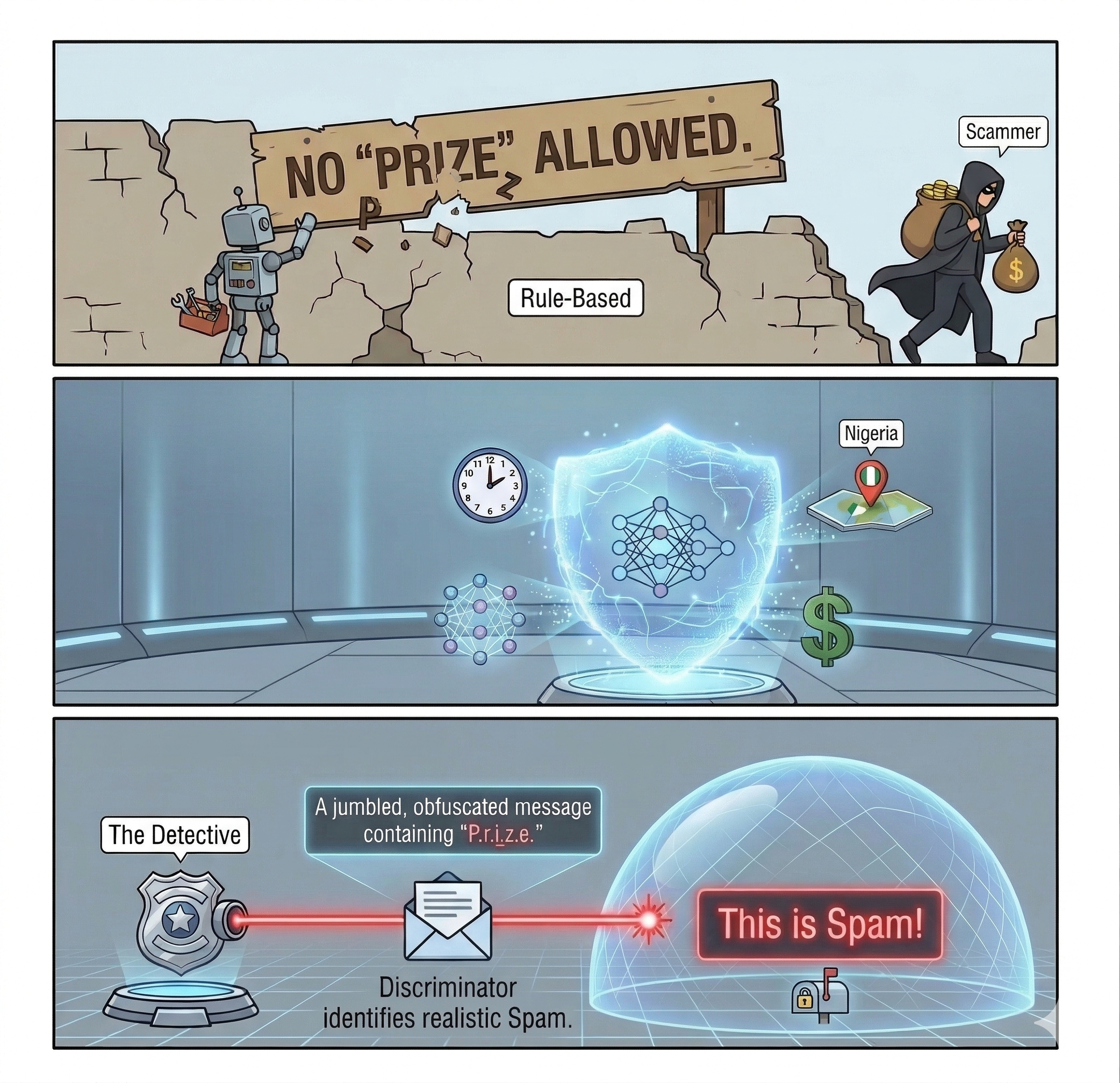
8. Real World Example: Spam Detection

The Traditional Approach Fails: Create a rule like "block emails mentioning 'prize'" and scammers simply write "pr!ze" or "p-r-i-z-e" to bypass it.

The Machine Learning Advantage:

  • "This person has never sent you an email before."
  • "This email came from Nigeria at 2 AM."
  • "There are lots of dollar signs ($$$) in the subject."

It synthesizes these patterns into a decision: "This looks like spam!"

9. Three Main Paths of Learning

1. Supervised Learning

Learning through a teacher (Labelled Data).

2. Unsupervised Learning

Self-discovery method (Unlabeled Data).

3. Reinforcement Learning

Learning from trial and error.

10. Supervised Learning: Learning with a Teacher

Think of this as learning with answer keys. You provide both the data and the correct answers (labels).

How It Works:

  • Training Phase: Feed it 10,000 labeled images: "cat", "dog", "bird"...
  • Pattern Recognition: The system identifies subtle features (ear shapes, fur patterns, etc.)
  • Testing: Show it a new image → "95% confident this is a dog"

Technical Note:

Garbage In = Garbage Out. If your labels are wrong, the answers will be wrong too!

11. The Hidden Labor Behind AI

Here's the dirty secret: The hardest part of supervised learning isn't fancy algorithms — it's the tedious human work of data labeling.

Example: Autonomous Vehicles

Teams of people manually draw bounding boxes around pedestrians, cars, and traffic signs in millions of video frames. It's painstaking work.

Behind every "smart" AI is an army of human labelers, often working through platforms like Amazon Mechanical Turk.
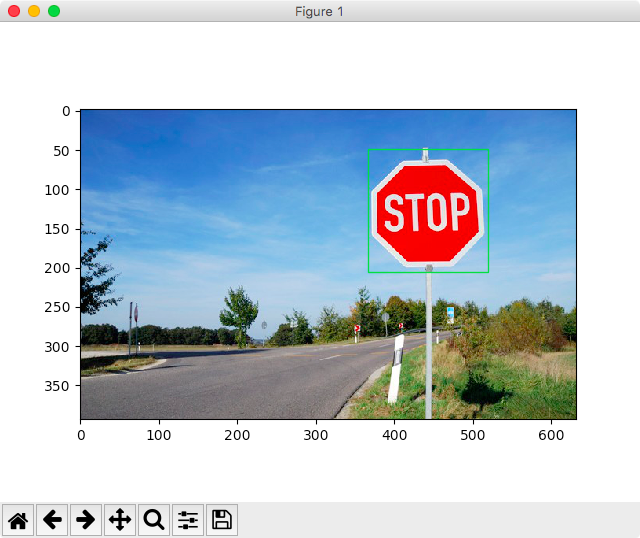
Data annotation concept

12. Unsupervised Learning: Finding Patterns Alone

No labels, no answers — just raw data. The system must find patterns on its own.

Example: Retail Store Data

Unlabeled data like purchased items, purchase frequency, amount spent.

What Happens:

  • The AI automatically discovers customer segments with similar buying patterns (using techniques like K-Means Clustering and RFM Analysis).

13. Business Magic: 3 Groups AI Identifies

1. VIP Customers

Identity: Frequent visitors, big spenders.

Strategy: No discounts needed; give recognition and exclusive relationship manager (VIP Status).

2. Discount Hunters

Identity: Only come when there's a sale.

Strategy: VIP perks are wasted. Send flash sale announcements like "50% off today only".

3. New Buds

Identity: First-time buyers.

Strategy: Warm welcome discount and loyalty program to convert them into loyal customers.

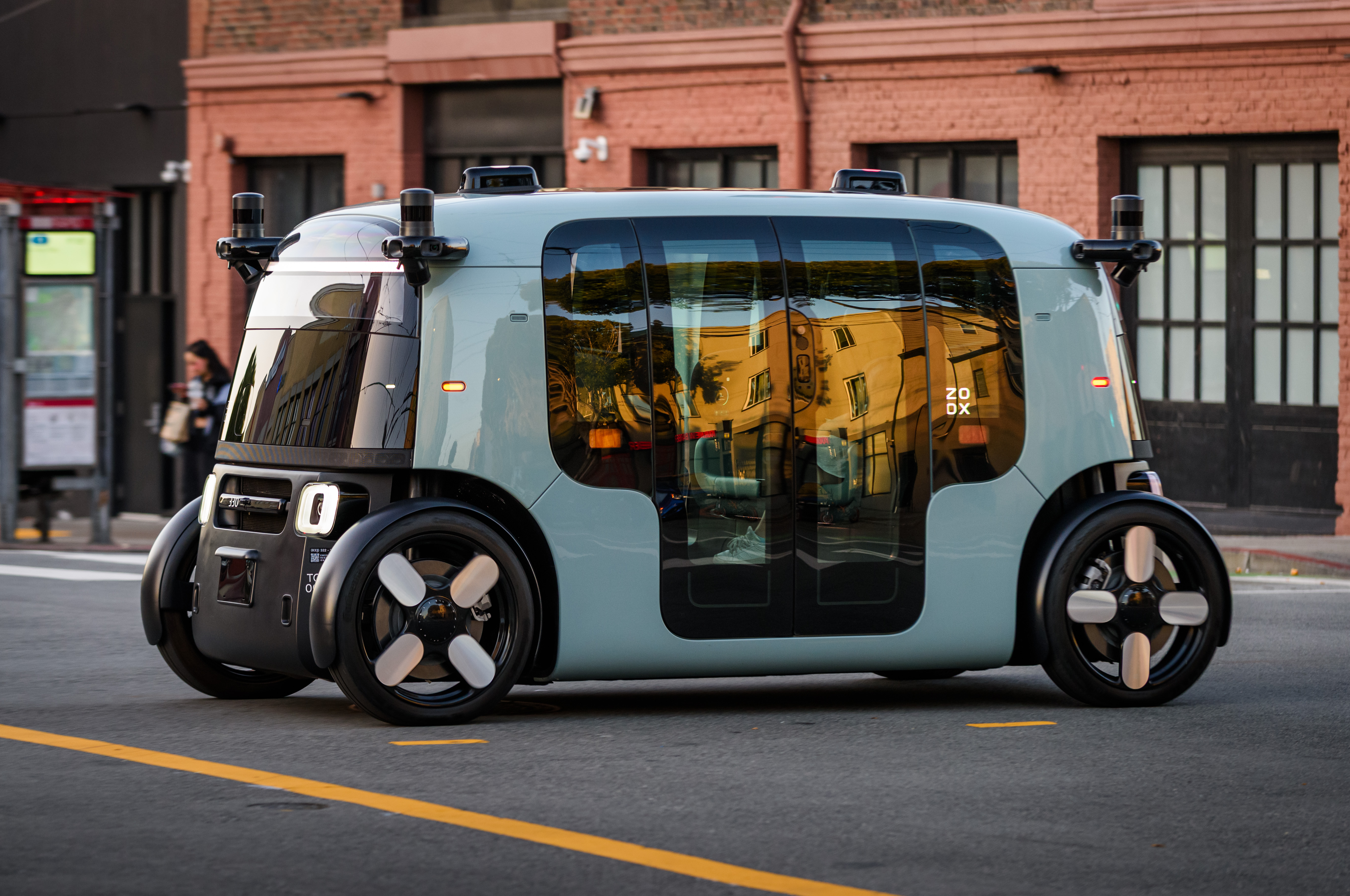
Self driving autonomous car

14. Reinforcement Learning: Trial, Error, Reward

The AI learns through experience — like a child discovering that touching a hot stove hurts. Every action has consequences.

Example: Autonomous Taxi

  • Drop off passenger safely → +10 points
  • Run a red light → -100 points
  • Through millions of simulations, it learns which behaviors maximize rewards.

15. A Historic Moment:
AlphaGo's "Move 37"

March 2016. Google's AlphaGo played its 37th move against world champion Lee Sedol. Every expert watching called it a blunder — a move that violated centuries of Go strategy.

They were wrong. Move 37 was brilliant — it secured AlphaGo's victory and changed Go forever. This was the moment we realized: AI can discover strategies beyond human imagination.

Third Layer:
Deep Learning

The powerhouse behind today's AI revolution. Multi-layered neural networks that loosely mimic how our brains process information.

16. Why "Deep"? Layers Build Understanding

"Deep" refers to multiple layers of processing. Like building a house: foundation first, then walls, then roof. Each layer builds on the previous one.

Layer 1 (Low-level)

Detects simple features: edges, corners, basic shapes.

Layer 2 (Mid-level)

Combines basic features into more complex patterns: eyes, ears, whiskers.

Layer 3 (High-level)

Synthesizes everything into the high-level concept: "This is a cat."

16a. Perceptron: Beach Decision

Sunday evening. Suppose you decide to go to the beach to relax. Your brain analyzes three main factors to make this decision:

Weather (x₁)

Is it nice weather outside, or raining?

x₁ = 1 (Nice weather)
x₁ = 0 (Rain)

Friend (x₂)

Does your friend want to come with you?

x₂ = 1 (Will come)
x₂ = 0 (Won't come)

Transport (x₃)

Is public transport (bus/train) nearby?

x₃ = 1 (Available)
x₃ = 0 (Not available)

These three factors can be given to our perceptron as inputs through binary (0 or 1) variables x₁, x₂, x₃.

16b. Weights: Assigning Importance

Each input gets a weight that reflects how much it matters to your decision. Let's say weather is your top priority:

The Decision Formula

w₁ = 6 → Weather
w₂ = 2 → Friend
w₃ = 2 → Transport
Threshold = 5

Decision Method

∑ = (w₁×x₁) + (w₂×x₂) + (w₃×x₃)

∑ ≥ 5 → 1 (Go)
∑ < 5 → 0 (Don't go)

16c. Seeing It in Action

Let's run through two scenarios and watch the perceptron decide:

Scenario 1: Nice Weather ☀️

x₁ = 1 (Nice weather)
x₂ = 0 (No friend)
x₃ = 0 (No transport)

∑ = (6×1) + (2×0) + (2×0) = 6

6 > 5 → Output: 1

✓ Go to the beach!

Scenario 2: Heavy Rain 🌧️

x₁ = 0 (Rain)
x₂ = 1 (Friend coming)
x₃ = 1 (Transport available)

∑ = (6×0) + (2×1) + (2×1) = 4

4 < 5 → Output: 0

✗ Stay home!

The Big Idea: By tuning weights and thresholds, we can completely reshape how a machine makes decisions. This is the foundation of neural networks!

17. Key Deep Learning Architectures

CNN (Convolutional Neural Network)

"Computer Vision Specialist"

Excels at understanding images and video. Inspired by how our visual cortex processes what we see.

Applications: Face ID, medical imaging (detecting tumors), self-driving car vision.

RNN (Recurrent Neural Network)

"Sequential Data Expert"

Designed for data with order and context: language, speech, time series. Has "memory" of what came before.

Applications: Siri and Alexa, real-time translation, stock prediction.

18. Why Now? The Perfect Storm

Neural networks have been around since the 1950s. So why did deep learning only explode in the 2010s? Three things converged:

  • Data Deluge: The internet gave us massive labeled datasets. ImageNet alone contains 14 million labeled images.
  • GPU Revolution: Graphics cards built for gaming turned out to be perfect for neural network math. What took weeks now takes hours.
  • Algorithmic Breakthroughs: Better training techniques (like improved backpropagation and ReLU activations) made deep networks actually trainable.

19. Vanishing Gradient Problem

The "Telephone Game" Problem

During training, the learning signal (gradient) must travel backward through all layers. But with each layer, it gets weaker and weaker until it vanishes into nothing.

Remember the "telephone game" where a message gets garbled as it passes through many people? Same problem here!

This roadblock stalled deep learning for decades. Modern fixes like ReLU activations and LSTM cells finally cracked it.

Backpropagation and Vanishing Gradient

The Innermost Layer:
Generative AI

From recognition to creation. Instead of asking "What is this?", generative AI asks "What if I made something new?"

Artist painting in gallery

20. GANs: A Creative Duel

Generative Adversarial Networks

Ian Goodfellow's 2014 breakthrough: teaching AI to create by making two neural networks compete against each other!

  • Generator (The Forger): Creates synthetic data trying to pass as real.
  • Discriminator (The Detective): Tries to spot the fakes from the real deal.
GAN Learning Cycle

21. The Training Arms Race

How They Improve Together

Round 1: Generator creates a crude blob. Discriminator easily spots it as fake.

After thousands of rounds: Generator gets better at faking. Discriminator sharpens its detection. Eventually, the fakes become indistinguishable from reality!

The Dark Side

  • Deepfakes: Frighteningly realistic fake videos that can manipulate public opinion.
  • Mode Collapse: Sometimes the generator gets stuck creating variations of the same thing over and over.
Next Token Prediction

22. Transformers & Large Language Models

The architecture powering ChatGPT, Gemini, and the AI writing revolution.

  • Next-Token Prediction: At its core, it's just predicting the next word based on what came before. Simple idea, profound results.
  • Attention Mechanism: The breakthrough that lets AI understand context. It learns which words to "pay attention to".
    Example: In "The animal didn't cross the street because it was too tired", attention helps determine "it" refers to the animal, not the street.

23. The Miracle of Scale

Emergent Abilities: More Is Different

GPT-3 has 175 billion parameters. Something magical happens at this scale: capabilities emerge that weren't explicitly programmed. The model wasn't trained to reason or translate, yet it does both.

"Because it rained, ____"

Small model: "the streets got wet" (predictable)

Large model: "children ran outside with paper boats while streams began to swell" (contextual understanding + creativity)

What's Next: Natural Language Processing

Language is where AI truly comes alive. All the techniques we've covered—machine learning, deep learning, transformers—reach their full potential when applied to human communication. Next chapter: we dive into the fascinating world of NLP.

1 / 28